03.05.2022
Im Fokus: US-Staatsanleihen-Renditekurve sendet gemischte Signale | Mai 2022
In the early days of the month of April, the closely watched 2Y/10Y yield curve has inverted multiple times over a short time span. High emphasis is put on this point of data as it has in the past often been synonymous in announcing a recession of the US economy. While many strategists explained that the rise in concern over this matter should not spark fear in the markets, others highlight putting the 2Y/10Y in correlation with the Consumer Optimism Gap clearly illustrates that a downward slopping yield curve matches a fall in consumer optimism and eventually provides fertile ground for a recession.
US 2Y/10Y - Average of 18 months from inversion to recession:
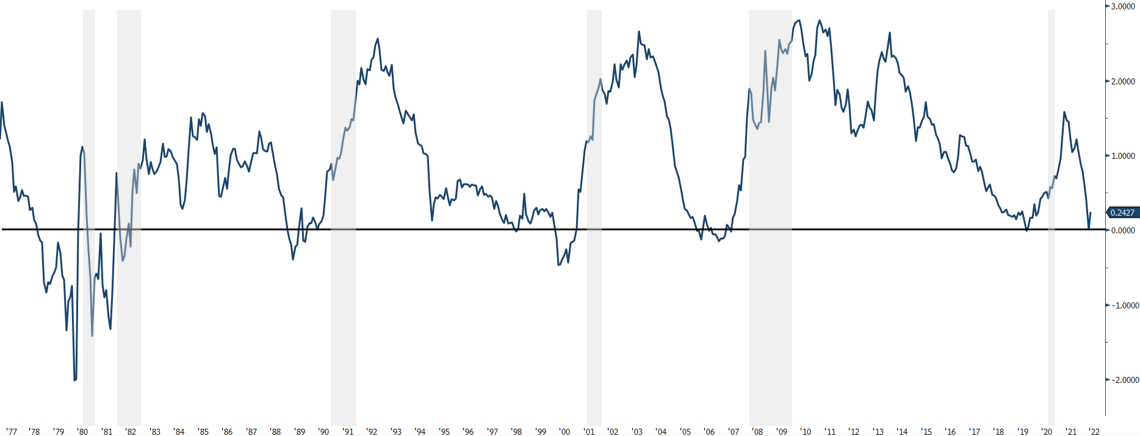
History tells us since the 1960s’ every recession where economic decline during which trade and industrial activity are reduced, generally identified by a fall in GDP in two successive quarters has only occurred after an inversion of the 2Y/10Y. Following this chain of thought, we can now suppose that additional risk is weighing in the basket in seeing a declining growth of the US economy in one to two years time following the rise of the 4th of May.
US 2Y/10Y vs Consumer Optimism Gap:

Don’t panic the 3M/10Y still remains steep
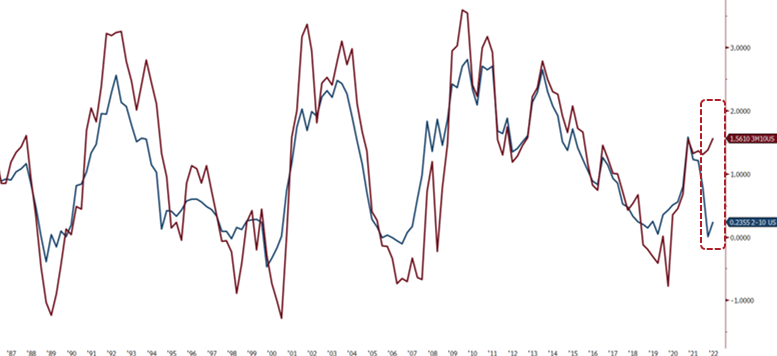
All yield curves between 2 and 10 years have inverted. Remains the 3 month, which is taking a steep route in positive territory. This phenomenon can be interpreted in two ways. The first could be a reflection of the FED being behind the curve. Something that should not last over the upcoming quarters as future hikes are on target.
An upward slopping curve happens when investors require additional return on debt as they envision greater default risk of the underlying or a possible fear of inflation. The divergence between the 3M/10Y could also be a signal of increasing hawkishness from the FED in the upcoming years.
Finally, while some mention an inversion of the 2Y/10Y leaves us on average more than a year and half to face a potential recession, it is worth highlighting that a recession occurring after a 1st rate hike in a cycle happens earlier when the 2Y/10Y inversion occurs during the hiking cycle. The last inversion of March 2022 occurred in the quickest time span recorded after the start of the hiking cycle.
US 3M/10Y vs 2Y/10Y:
Asset class performance post-inversion
The average performance post inversion of the S&P 500 does not show cast a clear pattern. No correlation can be established between the inversion and performance of US stock index before, during and after a cycle.
We should bear in mind that short and long-term dynamics shape the yield curve. Two years ago, before the COVID-19 outbreak the FED has cut its policy rate to near zero in order to limit the impact of a recession caused by the pandemic.
Fast forward to today’s terms, the FED has to “catch up” with growing inflation as both global and US economy recovers to its pre-pandemic levels. The T-Bill is facing strong global demand combined to the FEDs’ ongoing quantitative easing (QE) that has for effect to increase prices of bonds resulting in low yields. The steepness of short-term yields has caught a great deal of attention, ultimately opening the debate of future economic outlook on either an unconventional slowdown in growth or a strong signal of a US recession; the question remains open.
Mehr Publikationen
26.10.2026
CGE Connect von Cité Gestion: Mehrere Banken, eine mobile App
Wir sind stolz darauf, CGE Connect vorzustellen, unsere neue mobile App für mehrere Depotbanken, die sowohl für Kunden als auch für Kundenbetreuer konzipiert ist. Ein weiterer Schritt in unserem Bestreben, eine unabhängige, pragmatische und hochgradig personalisierte Vermögensverwaltung anzubieten.
Mehr dazu20.10.2026
Willkommen, Dinesh Kewlram!
Wir freuen uns, den Eintritt von Dinesh Kewlram bei Cité Gestion bekannt zu geben.
Mehr dazu16.10.2026
Psychische Gesundheit: ein boomender Markt
Als eines der am stärksten betroffenen Länder Europas wurde die psychische Gesundheit in Frankreich seit 2025 zu einem wichtigen nationalen Anliegen erklärt. Angesichts des enormen medizinischen Bedarfs und nach Jahrzehnten ohne nennenswerte Innovationen zeichnen sich nun endlich neue Durchbrüche ab, darunter insbesondere das grosse Comeback von LSD.
Jérôme Berton beleuchtet eines der wichtigsten Gesundheitsthemen, die wichtigsten Innovationsschwerpunkte sowie die Unternehmen, die davon profitieren werden.
Link zur Sendung14.10.2026
Wird Frankreich weiterhin in die Vergangenheit investieren oder anfangen, in die Zukunft zu investieren?
Angesichts steigender Schulden, Rentenkosten und Zinszahlungen läuft Frankreich Gefahr, die Chancen von morgen zu opfern, um die Verpflichtungen von gestern zu finanzieren.
Mehr dazu08.10.2026
Interview – Die wichtigsten Entwicklungen in der Vermögensverwaltungsbranche
In einem Exklusivinterview spricht unser CEO, Christophe Utelli, über die wichtigsten Entwicklungen in der Vermögensverwaltungsbranche sowie über unsere Antwort auf die Herausforderungen, die diese Entwicklungen mit sich bringen.
Cité Gestion möchte unabhängigen Vermögensverwaltern einen flexiblen Ansatz bieten, der unternehmerische Freiheit, operative Exzellenz und internationale Ausrichtung vereint. Ein Modell, das auf Multi-Booking, leistungsstarken technologischen Lösungen und dem Zugang zu den erweiterten Kapazitäten der EFG-Gruppe basiert.
05.10.2026
Ernennung von Bruno Cesana und Willkommen bei Jean-Christophe Faust!
Wir freuen uns, die Ernennung von Bruno Cesana zum Bankier sowie den Eintritt von Jean-Christophe Faust als Chief of Staff bekannt zu geben.
Mehr dazu