03.05.2022
In Focus: US Treasury yield curve sends mixed signals | May 2022
In the early days of the month of April, the closely watched 2Y/10Y yield curve has inverted multiple times over a short time span. High emphasis is put on this point of data as it has in the past often been synonymous in announcing a recession of the US economy. While many strategists explained that the rise in concern over this matter should not spark fear in the markets, others highlight putting the 2Y/10Y in correlation with the Consumer Optimism Gap clearly illustrates that a downward slopping yield curve matches a fall in consumer optimism and eventually provides fertile ground for a recession.
US 2Y/10Y - Average of 18 months from inversion to recession:
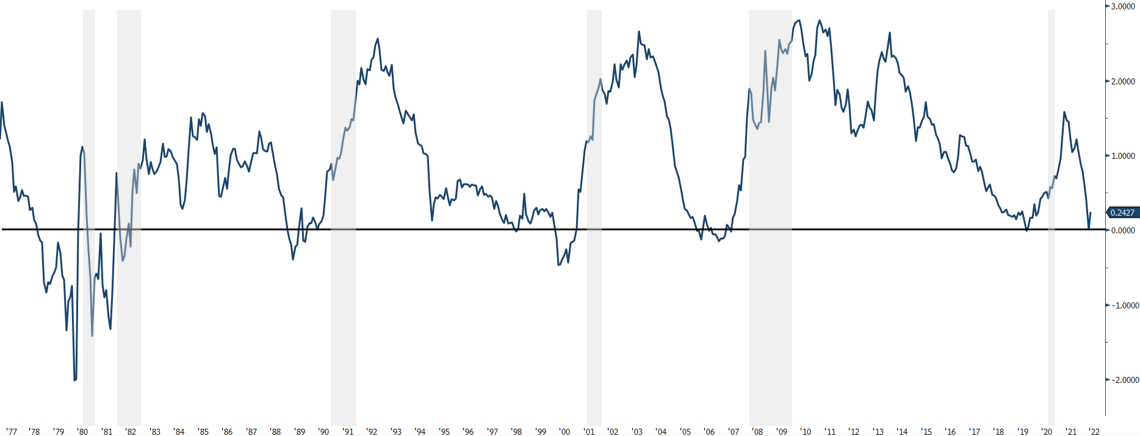
History tells us since the 1960s’ every recession where economic decline during which trade and industrial activity are reduced, generally identified by a fall in GDP in two successive quarters has only occurred after an inversion of the 2Y/10Y. Following this chain of thought, we can now suppose that additional risk is weighing in the basket in seeing a declining growth of the US economy in one to two years time.
US 2Y/10Y (blue) vs Consumer Optimism Gap (red):

Don’t panic the 3M/10Y still remains steep
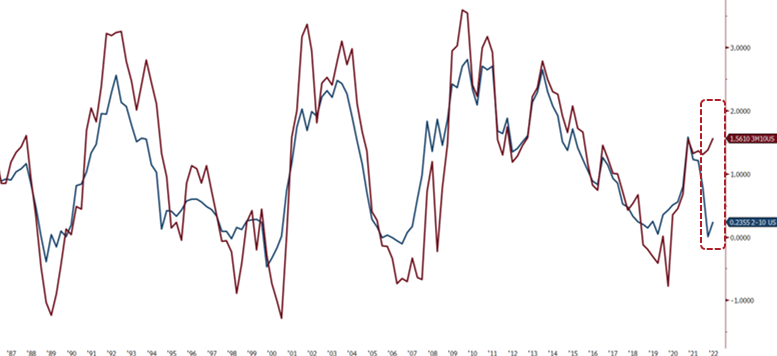
All yield curves between 2 and 10 years have inverted. Remains the 3 month, which is taking a steep route in positive territory. This phenomenon can be interpreted in two ways. The first could be a reflection of the FED being behind the curve. Something that should not last over the upcoming quarters as future hikes are on target following the rise of the 4th of May.
An upward slopping curve happens when investors require additional return on debt as they envision greater default risk of the underlying or a possible fear of inflation. The divergence between the 3M/10Y could also be a signal of increasing hawkishness from the FED in the upcoming years.
Finally, while some mention an inversion of the 2Y/10Y leaves us on average more than a year and half to face a potential recession, it is worth highlighting that a recession occurring after a 1st rate hike in a cycle happens earlier when the 2Y/10Y inversion occurs during the hiking cycle. The last inversion of March 2022 occurred in the quickest time span recorded after the start of the hiking cycle.
US 3M/10Y (red) vs 2Y/10Y (blue):
Asset class performance post-inversion
The average performance post inversion of the S&P 500 does not show cast a clear pattern. No correlation can be established between the inversion and performance of US stock index before, during and after a cycle.
We should bear in mind that short and long-term dynamics shape the yield curve. Two years ago, before the COVID-19 outbreak the FED has cut its policy rate to near zero in order to limit the impact of a recession caused by the pandemic.
Fast forward to today’s terms, the FED has to “catch up” with growing inflation as both global and US economy recovers to its pre-pandemic levels. The T-Bill is facing strong global demand combined to the FEDs’ ongoing quantitative easing (QE) that has for effect to increase prices of bonds resulting in low yields. The steepness of short-term yields has caught a great deal of attention, ultimately opening the debate of future economic outlook on either an unconventional slowdown in growth or a strong signal of a US recession; the question remains open.
More articles
26.10.2026
CGE Connect by Cité Gestion: Multiple banks, one mobile app
We are proud to launch CGE Connect, our new multi-custodian mobile app designed for both clients and relationship managers. Another step forward in our commitment to delivering independent, pragmatic and highly personalized wealth management.
Read more20.10.2026
Welcome to Dinesh Kewlram!
We are pleased to announce the arrival of Dinesh Kewlram at Cité Gestion.
Read more16.10.2026
Mental Health: A Booming Market
As one of the hardest-hit countries in Europe, mental health has been designated a major national cause in France since 2025. Faced with considerable medical needs and after decades without major innovation, new discoveries are finally emerging—notably the major resurgence of LSD.
Jérôme Berton analyzes one of the most important health issues, the main areas of innovation, and the companies positioned to benefit from them.
Link to the program14.10.2026
Will France keep financing yesterday, or start investing in tomorrow?
As debt, pension costs and interest payments rise, France risks sacrificing tomorrow's opportunities to finance yesterday's commitments.
Read more
08.10.2026
Interview - Major Trends in the Wealth Management Industry
In an exclusive interview, our CEO, Christophe Utelli, discusses the major trends in the wealth management industry as well as our response to the challenges these trends present.
Cité Gestion aims to offer independent portfolio managers a flexible approach that combines entrepreneurial freedom, operational excellence, and an international outlook. This model is supported by multi-booking, high-performance technological solutions, and access to the expanded capabilities of the EFG Group.
05.10.2026
Appointment of Bruno Cesana & welcome to Jean-Christophe Faust!
We are delighted to announce the appointment of Bruno Cesana as a banker and the arrival of Jean-Christophe Faust to the position of Chief of Staff.
Read more