09.10.2020
US-Wahlen: Welche Risiken sind bereits eingepreist?
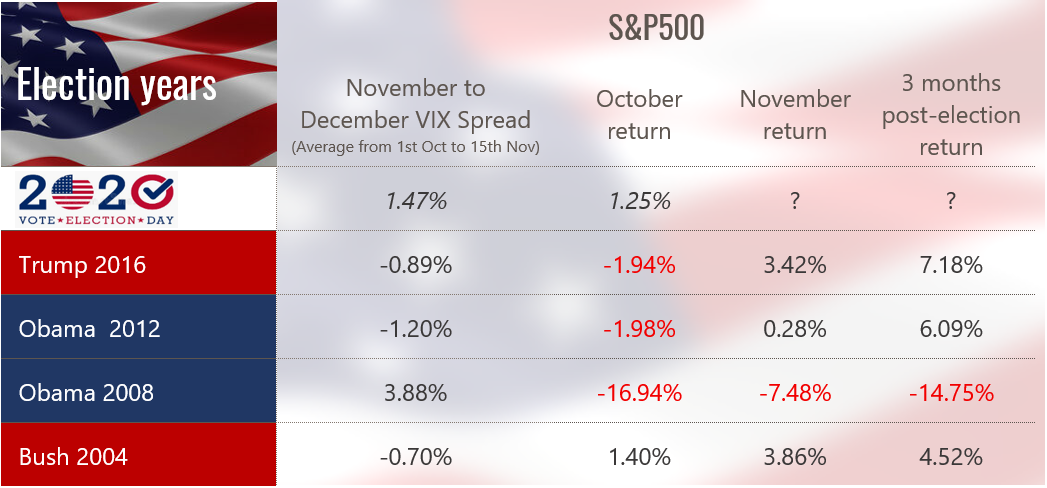
There is no doubt that a US presidential election represents a risk for financial markets and a good way to quantify how much risk is currently priced-in is to look at the forward implied volatility before and after the elections.
For that, the VIX index, a basket of the S&P 500 options volatility, sounds a good barometer.
Looking at the VIX curve, The November expiry is currently trading 1.5% above the December one, reflecting the immediate risk investors are facing post-election (November 3rd) relative to December.
While the 1.5% spread indicates a higher implied risk around and after the election, it does not quantify the absolute level of risk. To put it in perspective, we looked at the average November-December VIX Spread from October 1st to November 15th for every US Election since 2004.
Excluding the US election during the Great Financial Crisis in 2008 where spot volatility was structurally higher than 1, 2 and 3 months forward, it appears that a positive November/December VIX Spread is somewhat unusual. In fact, during the 2004, 2012 and 2016 elections, the November VIX never traded above the December one.
Looking at the return of the S&P in October, November and 3 months after the election, we can observe that it is very difficult to draw any conclusion over a US presidential election from a financial market perspective. If anything and excluding the 2008 election during the crisis, the simple and most direct conclusion would be that a US presidential election after 2000 had a positive impact on the S&P 500 Index one month and 3 months after the outcome.
So how to explain this extra-risk this time? We believe the 1.5% premium in November volatility relative to December likely reflects one single risk: if Biden wins, President Trump might not going to accept it. A sentiment that has been reinforced after the first TV debate of the US elections.
To conclude, history shows that financial markets can easily deal with a republican or democrat president but definitely not with no President after November 4th.
Mehr Publikationen
20.10.2026
Willkommen, Dinesh Kewlram!
Wir freuen uns, den Eintritt von Dinesh Kewlram bei Cité Gestion bekannt zu geben.
Mehr dazu16.10.2026
Psychische Gesundheit: ein boomender Markt
Als eines der am stärksten betroffenen Länder Europas wurde die psychische Gesundheit in Frankreich seit 2025 zu einem wichtigen nationalen Anliegen erklärt. Angesichts des enormen medizinischen Bedarfs und nach Jahrzehnten ohne nennenswerte Innovationen zeichnen sich nun endlich neue Durchbrüche ab, darunter insbesondere das grosse Comeback von LSD.
Jérôme Berton beleuchtet eines der wichtigsten Gesundheitsthemen, die wichtigsten Innovationsschwerpunkte sowie die Unternehmen, die davon profitieren werden.
Link zur Sendung14.10.2026
Wird Frankreich weiterhin in die Vergangenheit investieren oder anfangen, in die Zukunft zu investieren?
Angesichts steigender Schulden, Rentenkosten und Zinszahlungen läuft Frankreich Gefahr, die Chancen von morgen zu opfern, um die Verpflichtungen von gestern zu finanzieren.
Mehr dazu08.10.2026
Interview – Die wichtigsten Entwicklungen in der Vermögensverwaltungsbranche
In einem Exklusivinterview spricht unser CEO, Christophe Utelli, über die wichtigsten Entwicklungen in der Vermögensverwaltungsbranche sowie über unsere Antwort auf die Herausforderungen, die diese Entwicklungen mit sich bringen.
Cité Gestion möchte unabhängigen Vermögensverwaltern einen flexiblen Ansatz bieten, der unternehmerische Freiheit, operative Exzellenz und internationale Ausrichtung vereint. Ein Modell, das auf Multi-Booking, leistungsstarken technologischen Lösungen und dem Zugang zu den erweiterten Kapazitäten der EFG-Gruppe basiert.
05.10.2026
Ernennung von Bruno Cesana und Willkommen bei Jean-Christophe Faust!
Wir freuen uns, die Ernennung von Bruno Cesana zum Bankier sowie den Eintritt von Jean-Christophe Faust als Chief of Staff bekannt zu geben.
Mehr dazu30.09.2026
Kann die US-Wirtschaft mit einer Rendite von 5 % für 10-jährige Staatsanleihen zurechtkommen?
Erfahren Sie, warum höhere Zinsen, steigende Hypothekenkosten und teures Öl die US-Wirtschaft nicht gebremst haben.
Mehr dazu